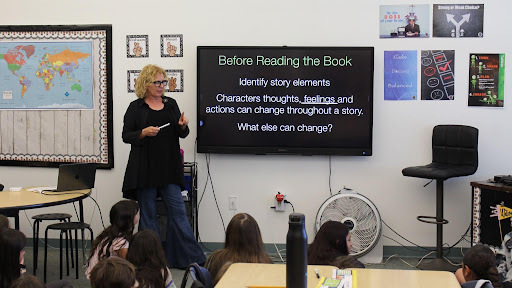
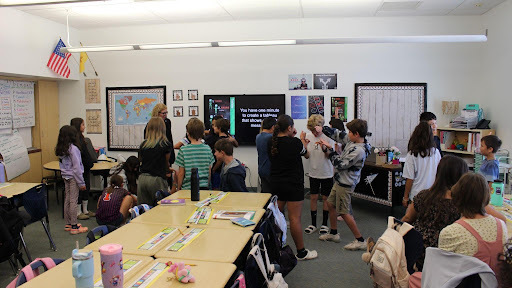
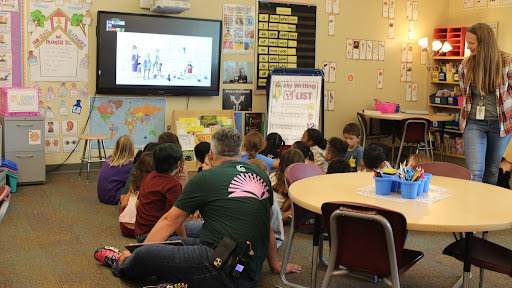
Before they read a single word of a book, the students at Enchanted Hills Elementary got out of their desks, gathered on the floor with music playing, and studied the book's illustrations, using what they saw to guess what the story might be about.
Then came the pairing up: find a partner, talk it over, two minutes. When time was up, the partners switched. This time, they buddied up with someone they hadn't worked with before. Each group shared what they thought the story was telling them, and only then did the class read the book together to see how their predictions held up.
Leading the lesson was Melanie Rick, a national teaching artist with the John F. Kennedy Center for the Performing Arts, who has been working with teachers and students at Enchanted Hills and Sandia Vista Elementary, the two schools with Rio Rancho Public Schools' arts integration program.
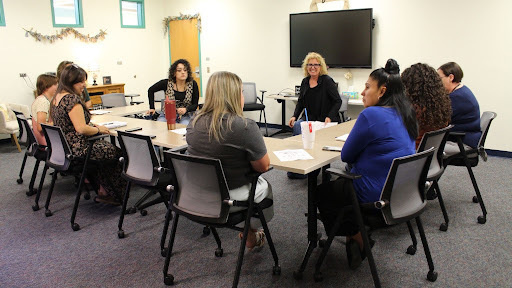
Her visit offered two different views of the work. At Sandia Vista, Rick quietly observed, taking notes as classroom teachers led arts-integrated lessons themselves. At Enchanted Hills, she took the lead, modeling strategies for teachers to watch in action. And afterward, the teachers sat down with her for a debrief, a candid conversation about what's working, what's challenging, and how arts integration is showing up in their classrooms.
More Than an Art Project
What exactly is arts integration? According to the Kennedy Center's definition, which RRPS follows, it is "an approach to teaching in which students construct and demonstrate understanding through an art form. Students engage in a creative process which connects an art form and another subject area and meets evolving objectives in both."
Or, as Dr. Kurt Schmidt, RRPS executive director of fine arts, explains it: think of students using dance to learn the water cycle. They move their bodies to imitate evaporation, condensation and precipitation. In the process, they learn the academic vocabulary of the water cycle and something about the elements of dance. Two sets of objectives, evolving together.
That's what makes arts integration different from the other ways the arts appear in schools. Arts as curriculum is the familiar band, choir or visual art class. Arts-enhanced curriculum uses the arts as a hook. For example, the ABC song helps kids memorize the alphabet, but the goal isn't to teach singing. Arts integration goes further: students learn about the art form and the subject at the same time.
"It just adds more tools to the teacher's toolbox," Schmidt explained.
A Partnership Years in the Making
The lessons Rick brings to Rio Rancho are part of a long-running effort. Since 2012, RRPS has partnered with the Santa Fe Opera through the Kennedy Center's Partners in Education program. Together they offer four to six arts integration workshops a year, open to any district employee.
Rather than create a single arts magnet school, the district chose to move two schools to the arts integration model, so they could learn together and lean on each other. The effort is modeled on the Belmar School of Integrated Arts in Colorado, and Enchanted Hills and Sandia Vista Elementary Schools launched the program at the start of the 2025-26 school year.
Built to Last
The professional development behind the program rests on two pillars. The first is "Acting Right," a classroom management approach developed by Kennedy Center teaching artist Sean Layne that uses the tools of drama, including concentration, cooperation and collaboration, to help students take ownership of their behavior. The second is Rick's "reading art" work, teaching students to read images the way they read text, which is exactly what those Enchanted Hills students were doing on the classroom floor.
"Professional development can't be a one-off," Schmidt said. "It's got to be sustained and intentional, and that's what we're trying to do to make sure this is successful."
Teachers at both schools also have access to online modules, plus a library of ready-made, standards-aligned lesson plans through the Kennedy Center's website. And the benefits are open well beyond the two schools: workshops welcome staff from every RRPS school, and teachers across the district are already using these strategies in their classrooms.
Kids Do the Heavy Lifting
Walk into an arts-integrated classroom and you'll notice something different: students out of their seats, talking to each other, building on each other's thinking. Instead of calling on a single student while the rest of the class' thinking goes unheard, the learning happens in conversation, with the teacher listening, assessing where each group is, and facilitating along the way.
During the Enchanted Hills lesson, Rick noticed a quieter group having a rich discussion. She let them know she'd heard their thinking and asked them to raise their hands when it came time to share. For students who hesitate to speak up, worried their idea might be wrong, that kind of encouragement can be just the boost they need.
In an arts-integrated classroom, teachers relinquish a measure of control, "letting the kids do the heavy lifting," as Schmidt puts it, without ever stepping away from their role facilitating the learning.
Ultimately, the goal is to reach every student. "Teachers need several approaches to meet the needs of their students," Schmidt noted. Students arrive at different levels, with different backgrounds and different needs, and the more tools teachers have, the better.
And for the adults, the work can be energizing, too. Teachers Schmidt has met over the years, including educators at the Colorado school that inspired the program, have said the approach reinvigorated their teaching, with some who were ready to retire deciding to stay in the classroom.
That's the hope in Rio Rancho: at Sandia Vista and Enchanted Hills, a fresh way to teach and a fresh way to learn, with workshops and resources making arts integration strategies available to staff throughout RRPS.